Chapter 3 of 10
Chapter 3: Basic Greetings & Introductions
Say hello, introduce yourself with わたしは〇〇です, and learn particles は and です.
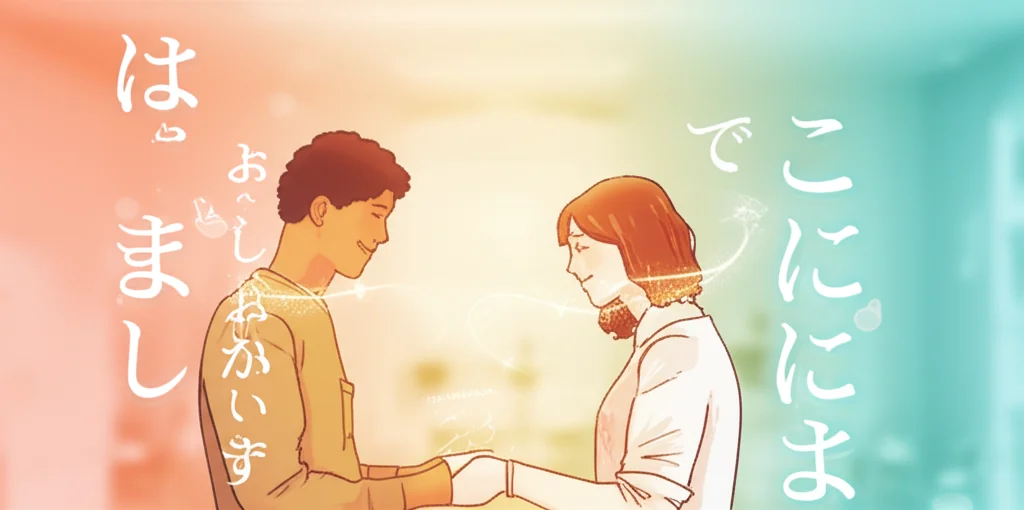
👋 Hello! Let's Greet!
Greetings are the first step to connecting with people in any language. In Japanese, politeness and context are key, even for simple greetings!
Essential Greetings:
Pronunciation: "Kohn-nee-chee-wah" (The "n" is a soft, nasal sound, almost like "mm" before "n")
Meaning: Hello / Good Afternoon
Usage: This is a general greeting usable from late morning through early evening. It's safe to use in most situations.
Pronunciation: "Oh-hah-yoh" (Elongate the "oh" sound at the end)
Meaning: Good Morning (casual)
Usage: Used in the morning, typically before noon. This is a more casual version, often used among friends or family.
For a polite version, add "ございます" (gozaimasu):
Pronunciation: "Oh-hah-yoh goh-zah-ee-mah-soo"
Meaning: Good Morning (polite)
Use this when addressing someone you don't know well, elders, or superiors.
Pronunciation: "Kohn-bahn-wah" (Again, a soft, nasal "n")
Meaning: Good Evening
Usage: Used when greeting someone in the evening, after the sun sets.
Pronunciation: "Sah-yoh-nah-rah" (Elongate the "oh" sound)
Meaning: Goodbye
Usage: While commonly taught, "Sayounara" often implies a longer separation or a final goodbye. More casual goodbyes like "Mata ne" (See ya) or "Ittekimasu" (I'm leaving, but will be back) are often used in daily life, but "Sayounara" is perfectly fine for basic learners.
🗣️ Introducing Yourself
Ready to tell people who you are? Here's how to make your first impression!
Basic Introduction Phrase:
Pronunciation: "Wah-tah-shee wah (your name) dess"
Meaning: I am 〇〇.
Replace 〇〇 with your name! For example, if your name is Alex (アレックス - Arekkusu):
Meeting Someone New:
Pronunciation: "Hah-jee-meh-mah-shee-teh"
Meaning: Nice to meet you. / How do you do?
Usage: This phrase is used when meeting someone for the very first time. It literally means "This is the first time (we meet)."
Pronunciation: "Yoh-roh-shee-koo oh-neh-gah-ee-shee-mah-soo"
Meaning: Pleased to meet you. / Please treat me well. / I look forward to working with you.
Usage: This phrase is incredibly versatile and common in Japanese. It doesn't have a direct English equivalent but conveys a sense of "please be kind to me" or "I'm looking forward to a good relationship." It's almost always said after "Hajimemashite" when introducing yourself.
Putting it all together:
Scenario: Meeting someone new for the first time.
はじめまして。
わたしはアンナです。
よろしくおねがいします。
(Translation: Nice to meet you. I am Anna. Pleased to meet you.)
📚 Grammar Spotlight: は (wa) & です (desu)
These two are foundational in Japanese! Let's break them down.
Particle は (wa) - The Topic Marker
The particle は (pronounced "wa", even though it's written with the character for "ha" ハ) always comes after the topic of the sentence. It tells the listener "What I'm about to say is about THIS."
Think of it like saying, "As for [topic], ..." or "Speaking of [topic], ..."
Structure: [Topic] は [Information] です。
Example:
Meaning: I am a student. (Literally: "As for me, I am a student.")
Here, わたし (watashi, I) is the topic of the sentence.
Copula です (desu) - The Polite "To Be"
です (desu) is a polite form of the verb "to be." It's used to state facts, identify things, or describe states.
It acts like "is," "am," or "are" in English, but it always comes at the end of a sentence and makes the sentence polite.
Structure: [Noun/Adjective] です。
Example:
Meaning: This is a book.
Remember: です adds politeness. When you're learning, it's safest to use です.
🎎 Cultural Note: Politeness in Japanese
Japanese society places a high value on politeness and respect, which is deeply embedded in the language. There are different levels of politeness (keigo 敬語) depending on who you are speaking to (e.g., family, friends, strangers, superiors, elders).
- Formal vs. Informal: The greetings and introduction phrases we learned in this chapter are generally polite forms suitable for most situations, especially when speaking to new acquaintances or people of higher status.
- Bowing (お辞儀 - Ojigi): While not directly part of the language, bowing is a common non-verbal greeting. A slight bow (around 15 degrees) is suitable for casual greetings, while deeper bows (30-45 degrees) are for more formal situations or showing respect/apology. You don't always need to bow, especially with foreigners, but it's a good gesture to be aware of!
- "Sumimasen" (すみません): This is a super versatile word meaning "excuse me," "I'm sorry," or "thank you for your trouble." You'll hear it often in Japan!
Don't worry about mastering all levels of politeness right away. For now, focusing on the polite forms like those ending with です (desu) and using phrases like "Hajimemashite" will serve you well!
🧠 Exercises: Test Your Knowledge!
Exercise 1: Match the Greeting!
Match the Japanese greeting to its English meaning.
1. こんにちは
a) Good Evening
b) Good Morning
c) Hello / Good Afternoon
2. おはようございます
a) Good Evening
b) Good Morning (polite)
c) Goodbye
3. さようなら
a) Goodbye
b) Nice to meet you
c) Hello
Think about your answers!
Exercise 2: Complete the Introduction!
Fill in the blanks to complete the introduction. (Imagine you are Maria - マリア, Maria)
はじめまして。
わたしはです。
よろしくおねがいします。
What's the missing word in the second line? (It's your name!)
Think about "Maria" in Japanese!
Exercise 3: Practice Pronunciation!
Tap the 🔊 icon and try to repeat the phrase. Focus on matching the sound!
こんにちは
おはようございます
わたしはトムです
よろしくおねがいします
Chapter quiz
Japanese Chapter 3 Quiz: Basic Greetings & Introductions
10 questions
- 1
What does こんにちは mean?
- 2
What does おはよう mean?
- 3
What does こんばんは mean?
- 4
What does さようなら mean?
- 5
What is the particle は used for in Japanese?
- 6
Form the Japanese sentence "I am Tanaka"
Tap tiles in order to build the answer - 7
What does はじめまして mean?
- 8
Form the Japanese phrase "Nice to meet you, please treat me well"
Tap tiles in order to build the answer - 9
What does the copula です mean?
- 10
Form the Japanese sentence "I am a student"
Tap tiles in order to build the answer
You know the lesson. Now practice speaking it.
Continue in Native Talk with story scenes and conversation battles built for natural Japanese.