Chapter 6 of 10
Chapter 6: Numbers, Time, and Counters
Count 1–10, ask the time, learn days of the week, and use に for time and location.
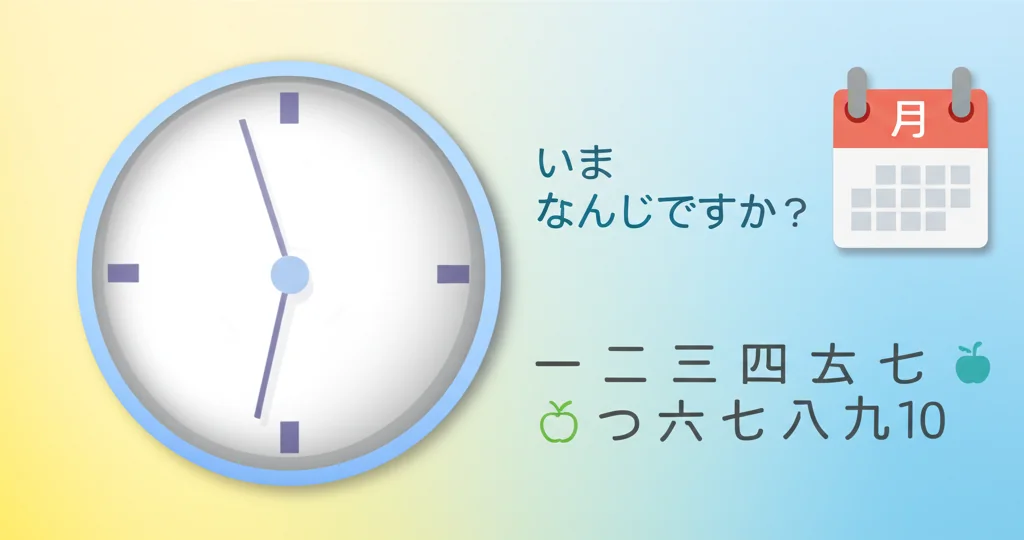
Welcome to Chapter 6! ⏰
Ready to count, tell time, and talk about your week in Japanese? This chapter is packed with practical phrases and essential vocabulary you'll use every day!
Understanding numbers is fundamental, and in Japanese, they come with a twist: counters! Don't worry, we'll start with the simplest ones.
Counting Basics: Numbers 1-10 🔢
Let's start with the building blocks – numbers 1 to 10. These are crucial for everything from telling time to counting objects.
- 1: いち (ichi)
- 2: に (ni)
- 3: さん (san)
- 4: よん / し (yon / shi)
(Note: よん is more common for counting things, し often used for months/time.) - 5: ご (go)
- 6: ろく (roku)
- 7: なな / しち (nana / shichi)
(Note: なな is more common in general conversation.) - 8: はち (hachi)
- 9: きゅう / く (kyuu / ku)
(Note: きゅう is more common in general conversation.) - 10: じゅう (jū)
💡 Cultural Note: Lucky & Unlucky Numbers
The number 4 (四, shi) sounds like 死 (shi), meaning "death," so it's often avoided in hospitals or apartment numbers. Similarly, 9 (九, ku) can sound like 苦 (ku), meaning "suffering" or "agony."
Because of this, you often hear よん (yon) for 4 and きゅう (kyuu) for 9.
Telling Time: じかん (jikan) ⏰
To tell time in Japanese, you mostly add ~じ (-ji) after the number for "o'clock."
Examples:
- 1 o'clock: いちじ (ichi-ji)
- 2 o'clock: にじ (ni-ji)
- 7 o'clock: しちじ (shichi-ji)
(Note: For 7 o'clock, しちじ is used, not ななじ.) - 9 o'clock: くじ (ku-ji)
(Note: For 9 o'clock, くじ is used, not きゅうじ.)
Asking the Time: いま なんじですか?
This is a super useful phrase!
いま (ima) - now なんじ (nan-ji) - what time? ですか (desu ka) - is it? (question particle)
Question: いま なんじですか?
(Ima nan-ji desu ka?) - What time is it now?
Answer: さんじです。
(San-ji desu.) - It's 3 o'clock.
Basic Counters: ~つ (~tsu) 🍎
In Japanese, you often need to use a "counter" depending on what you're counting. It's like saying "two *pieces* of bread" or "three *sheets* of paper" in English. For general, non-specific small items, we use the ~つ (~tsu) counter system.
This counter system is used for numbers 1 to 10 and applies to many common, everyday objects when you just want to say "one of something," "two of something," etc., without specifying the shape or type of object.
- 1 item: ひとつ (hitotsu)
- 2 items: ふたつ (futatsu)
- 3 items: みっつ (mittsu)
- 4 items: よっつ (yottsu)
- 5 items: いつつ (itsutsu)
- 6 items: むっつ (muttsu)
- 7 items: ななつ (nanatsu)
- 8 items: やっつ (yattsu)
- 9 items: ここのつ (kokonotsu)
- 10 items: とお (tō)
Example: You are buying apples at a market. You can say:
りんごを ふたつ ください。
(Ringo o futatsu kudasai.)
Please give me two apples.
Days of the Week: 曜日 (yōbi) 📅
Learning the days of the week is essential for making plans! Most days end with ~ようび (~yōbi), which means "day of the week."
The kanji for each day often relates to a celestial body or element, which is a fun cultural connection!
- Monday: 月曜日 (getsuyōbi) - Moon day 🌙
- Tuesday: 火曜日 (kayōbi) - Fire day 🔥
- Wednesday: 水曜日 (suiyōbi) - Water day 💧
- Thursday: 木曜日 (mokuyōbi) - Wood/Tree day 🌳
- Friday: 金曜日 (kin'yōbi) - Gold/Money day 💰
- Saturday: 土曜日 (doyōbi) - Earth/Soil day 🌍
- Sunday: 日曜日 (nichiyōbi) - Sun day ☀️
💡 Cultural Note: Kanji Meaning for Days
Notice how the kanji used for each day relates to a natural element or celestial body. This is similar to how English days are named after Norse or Roman gods (e.g., Tuesday from Tiw's day, Sunday from Sun's day)!
Grammar Focus: Particle に (ni) for Time and Location 📍⏰
The particle に (ni) is incredibly versatile! It indicates a specific point in time or a specific location where an action takes place.
に for Time (Specific Point)
Use に after a specific time (like a day of the week, a specific hour, or a date) to indicate *when* something happens.
- かようび に (kayōbi ni) - on Tuesday
- ごじ に (go-ji ni) - at 5 o'clock
Example Sentence:
わたしは もくようび に がっこうへ いきます。
(Watashi wa mokuyōbi ni gakkō e ikimasu.)
I go to school on Thursday.
に for Location (Target of Movement/Existence)
When used with verbs of existence (like います imasu - to be, for living things; あります arimasu - to be, for inanimate things) or verbs of movement, に indicates the specific location *at* which something is, or *to* which someone/something moves.
- レストラン に (resutoran ni) - at the restaurant / to the restaurant
- いえ に (ie ni) - at home / to home
Example Sentence (Existence):
えき に あります。
(Eki ni arimasu.)
It is at the station.
Example Sentence (Movement):
わたしは とうきょう に いきます。
(Watashi wa Tōkyō ni ikimasu.)
I go to Tokyo.
Practice Time! ✏️
Test your knowledge with these quick exercises!
Exercise 1: Numbers 🔢
How do you say "3" in Japanese?
さん (san)
How do you say "7" (the more common way) in Japanese?
なな (nana)
Exercise 2: Time ⏰
How do you ask "What time is it now?"
いま なんじですか? (Ima nan-ji desu ka?)
How do you say "4 o'clock" in Japanese?
よじ (yo-ji)
(Note: For 4 o'clock, よじ is used, not よんじ.)
Exercise 3: Basic Counters (~つ) 🍎
How do you say "5 items" (using the ~つ counter)?
いつつ (itsutsu)
How do you say "2 items" (using the ~つ counter)?
ふたつ (futatsu)
Exercise 4: Days of the Week 📅
What is "Tuesday" in Japanese?
火曜日 (kayōbi)
What is "Sunday" in Japanese?
日曜日 (nichiyōbi)
Exercise 5: Particle に (ni) 📍⏰
Translate: "I go to the library on Friday."
わたしは きんようび に としょかんへ いきます。
(Watashi wa kin'yōbi ni toshokan e ikimasu.)
Translate: "There is a cat at the park."
こうえん に ねこが います。
(Kōen ni neko ga imasu.)
Chapter 6 Wrap-up 🎉
Congratulations! You've mastered numbers 1-10, learned how to tell time, count basic items with ~つ , and even how to name all the days of the week! Plus, the powerful particle に is now in your grammar toolkit.
These are truly fundamental building blocks for daily conversations. Keep practicing, and you'll be giving directions and making appointments in Japanese in no time!
おつかれさまでした! (Otsukaresama deshita!) - Good work!
Chapter quiz
Japanese Chapter 6 Quiz: Numbers, Time, and Counters
10 questions
- 1
What does いま なんじですか mean?
- 2
What is the Japanese word for "time"?
- 3
What does 月曜日 mean?
- 4
What does 火曜日 mean?
- 5
What particle is used for time and location in Japanese?
- 6
Form the Japanese sentence "I go to school at 8 o'clock"
Tap tiles in order to build the answer - 7
What is the basic counter for counting objects in Japanese?
- 8
How do you say "one" in Japanese?
- 9
Form the Japanese sentence "I study at 9 o'clock"
Tap tiles in order to build the answer - 10
What does 水曜日 mean?
You know the lesson. Now practice speaking it.
Continue in Native Talk with story scenes and conversation battles built for natural Japanese.